
TIME TO JUST THINK
…dim reflection…

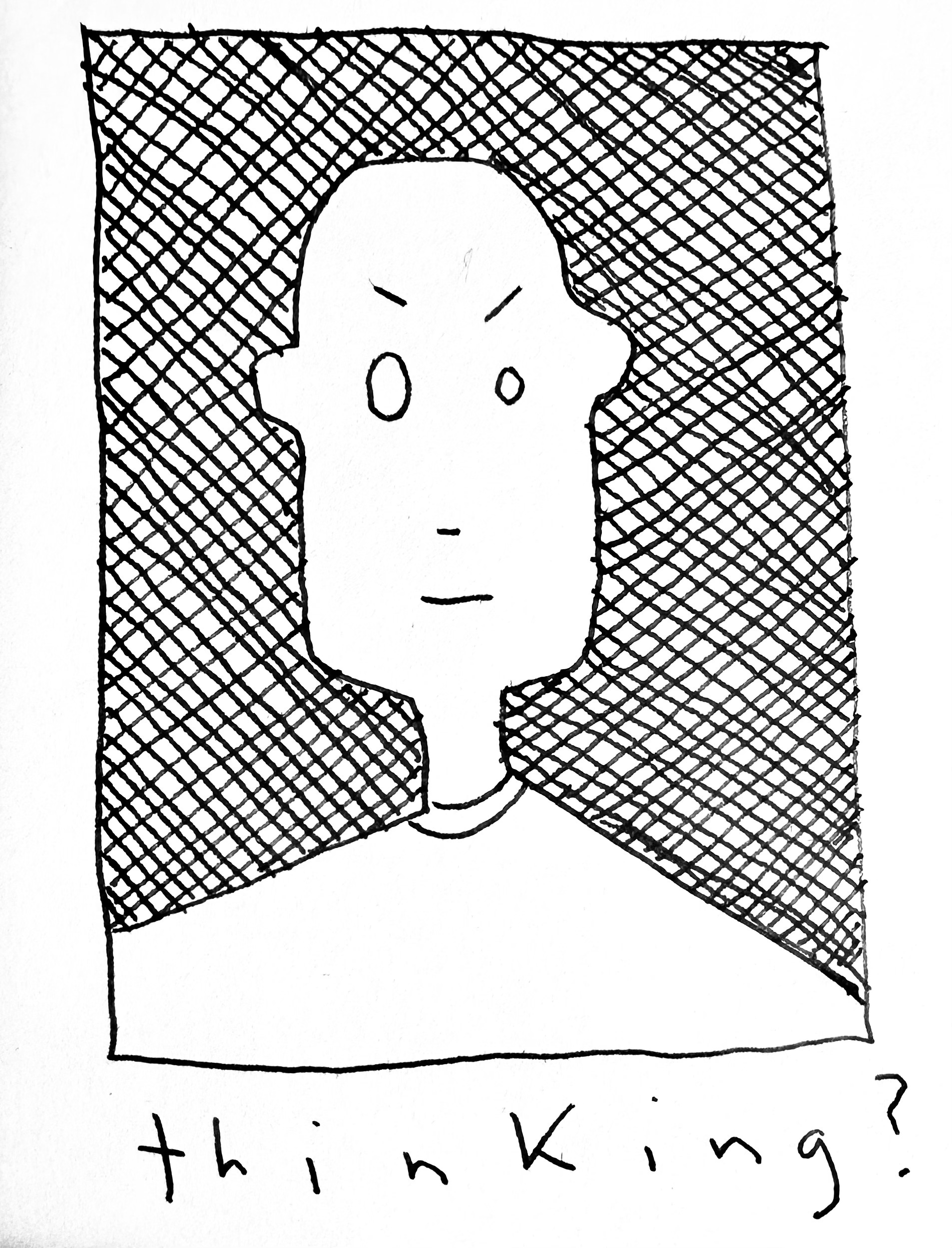
…so, we live in days of content: churning oceans of it, endlessly washing over us. Books, streaming series, television, newspapers, social media and doom-scrolling, podcasts playlists, and games played with strangers across the globe—there is simply too much to consume. To live now is to become a constant content masticator.
And so we munch away. Some of us are giraffes, selecting particular leaves at a certain height. Others are goats, indiscriminately grinding whatever comes within reach. Either way, the volume overwhelms us. The content we manage to consume begins to shape our conversations, our desires, even our sense of self. Our minds are so occupied that we leave little room to simply sit and think. There is just more content waiting for us to eat.
I have more discretionary time now that I am “rewilding” (read: retired), yet I still find myself filling every lacuna of the day with consumption. Ah! When a day is full, I feel productive—despite the fact that I have mostly been absorbing rather than creating.
And yet, if a day is filled with content fiber that is satisfying but not very nutritious, what then? How much of what we consume is memorable, life-changing, useful, or genuinely inspiring? One might expect that engaging with so much material would make us better thinkers, ethicists, citizens—or at least better people. I am not convinced it does. One thing is certain: I spend far less time thinking than I once did.
When I was young, there were three television channels in the UK. We were not really allowed to use the record player or hi-fi system—though we did so covertly, listening loudly and illicitly to Sgt. Pepper’s Lonely Hearts Club Band when the house was empty. We had books, but many were arcane or adult—The Alexandria Quartet, Miss Mapp. My mother did not subscribe to the idea of “age-appropriate” reading in our easily accessible library. Thank God we didn’t even have access to the dreadful pablum of “young adult fiction.” We were always reaching beyond our grasp, confused, stretching, forced to ponder ideas that didn’t immediately resolve. That struggle was good for our minds. We were becoming thinkers without really knowing it.
Around that same time, I also remember sitting cross-legged in our school gymnasium at Crosfields. We were required to sit in complete silence with our thoughts. At the start of the school year it was only a minute or two. By the end, it had grown to ten minutes. Three hundred children, largely still, with only minimal fidgeting—our monkey minds noticeably calmer. This was due to the vision of our Quaker Head of School, Roy Stillman. He wanted us to become thinkers—deep thinkers. He believed that this collective practice could lay a foundation for calm, patient thought that would carry into adulthood; it was a promising hypothesis.
I also had an English teacher there, Mr. Wassell, who was inspired by Edward de Bono, a noted physician and thinker in the seventies. He used de Bono’s CoRT Thinking Program as a part of our studies for the year. We were exposed to certain case studies that progressed in difficulty that were intended for us to understand concepts such as the power of assumptions and causality. It was again a good apprenticeship in thinking.
Years later, I attended a Quaker meeting house outside Princeton, New Jersey. Sitting silently now in a beautiful wood-paneled room. I discovered that, as an adult, I had not improved much at sitting silently with my thoughts. Twenty seconds in, my mind was already leaping wildly from branch to branch. After several Sunday mornings sitting there, I became marginally better. I wish I had spent more time there.
Today, we do almost the opposite with children. We fill their time with activities—endless activities. Boredom, or simply thinking, feels too dangerous. We keep them perpetually busy, denying their minds the chance to wander—or to wonder. In doing so, we also prevent them from developing the capacity to be alone with their thoughts. As they grow older, they seek constant action and stimulation. Time spent with oneself feels uncomfortable, even threatening. No wonder there is so much anxiety around these days: Better keep busy or I will need a Xanax.
Now we are asking machines to do the difficult thinking for us as well. Rather than supporting thought, computers increasingly replace it. Soon, much of what we once called thinking may be distributed across teams of AI agents, sparing us the awkward, effortful, and sometimes painful act altogether.
I wish we could reclaim more time to simply think and to become comfortable thinking. To lie on a couch and allow the mind to move where it will. At first, it would circle the mundane—what’s for dinner, what needs doing tomorrow? But with practice, it might begin to wander further, into deeper territory, to existential questions. Those thoughts could improve our lives, and perhaps the lives of those around us.
Thinking well takes practice. At first it can feel clumsy, even uncomfortable. But like any skill, it becomes easier—and richer—the more one does it. If we learned to think better, we might become better citizens, partners, parents, and people. I hope that rather than remaining uncomfortable with thinking or fobbing it off on some clueless machine, that we can spend some time learning to love our very own thinking.
That seems worth the effort.
Keep well—and think more…