
EUGÈNE CHRISTOPHE
…self-reliance…

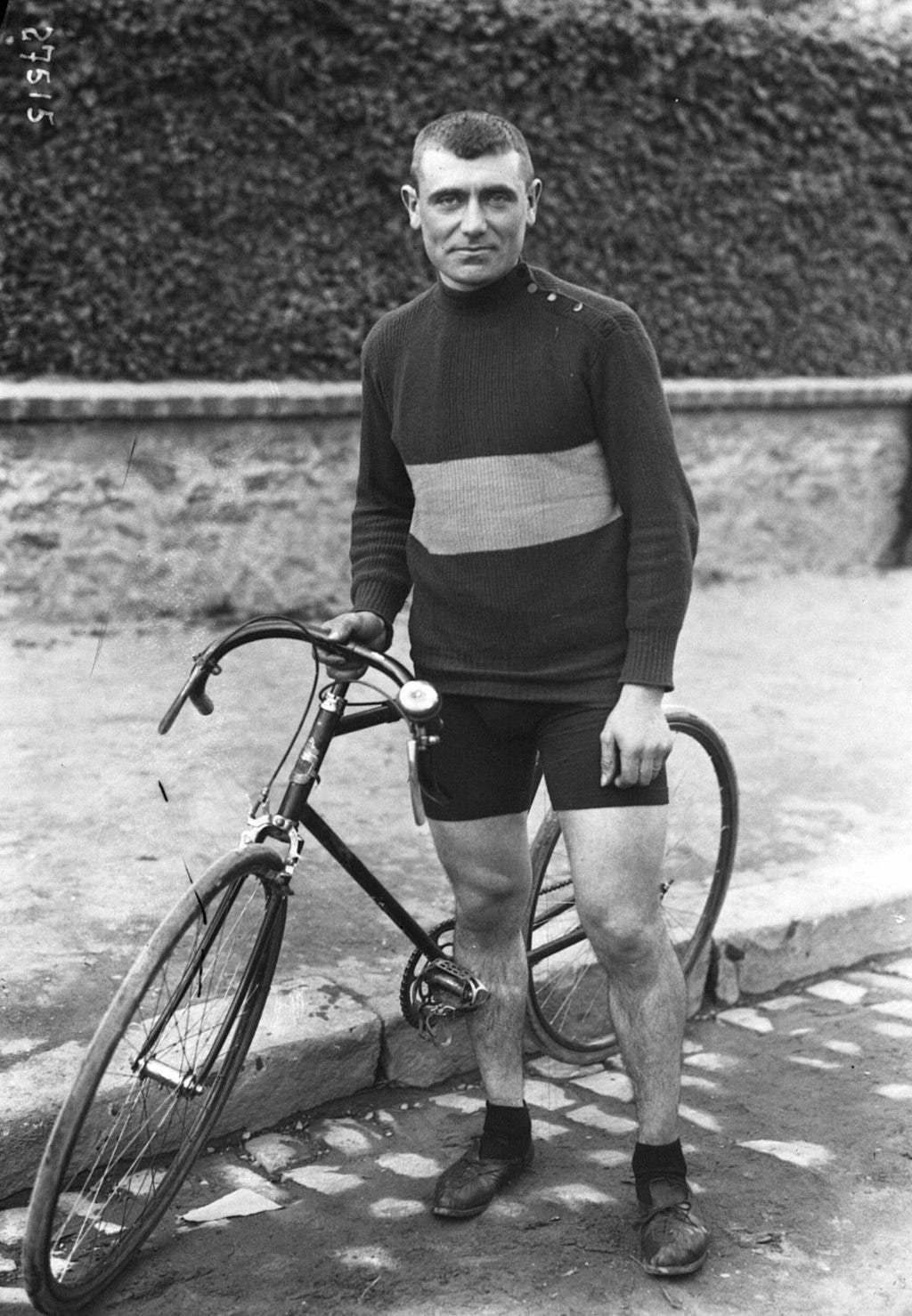
I have been watching the Tour de France as I do most summers. It feels nostalgic. I am less concerned with the teams or the actual competition, but I like connecting with the history of the race. I enjoy hearing my wife Kris’s memories about watching the arrivals of Anquetil and then Poulidor at Luchon in the Pyrenees. I remember watching the rivalry of Hinault, Lemond and Fignon in the eighties shown on the weekend on the television. I like hearing about the ascents of the famous cols in the mountains of southern and eastern France.
In some ways, I am more enamored of the Tour’s past than the physiological intensity of modern racing. I like some of today’s competitors, such as Jonas Vingegaard, but I prefer the era of steel bicycles and heavy wool jerseys. I’m also partial to contemporary historic races like the L’Eroica in Tuscany, which revive the older style of racing on bikes from the fifties, sixties, and seventies.
One story I find particularly intriguing is that of Eugène Christophe, a leading cyclist of the early twentieth century. In the 1913 Tour, during the descent from the Tourmalet, the front forks of his bicycle broke. At that time, riders were not allowed to receive outside assistance — they had to be entirely self-reliant. Christophe, close to a village, sought out the local blacksmith. There, he had to craft a new set of forks entirely by himself. The blacksmith, Monsieur Lecomte, was permitted to offer verbal guidance, but Christophe did the work. This detour ended up costing him the race, but the story became mythic — a symbol of a race that demanded not only athletic prowess but also ingenuity and resilience. He had to resolve things himself but also with some help from a village.
Thinking about this now, it feels almost foreign and archaic. And yet, it’s deeply appealing, far more so than the overly planned and predetermined competitions of our time. Today, a race requiring such broad self-reliance seems unimaginable — and that feels like a loss. We have privileged specialization so heavily that the self-sufficient generalist has become disadvantaged.
My mother, Marie-Jose Randolph, believed that my brother Adrian and I should become self-reliant beings. She encouraged us to cook, build, play instruments, travel, and experience different cultures. For her, self-reliance was elemental. So much so that she lived, well into later life, in a cabin in New Hampshire, with its own water source, septic system, and wood stove, using wood cut from her own land. Live Free or Die!
As I’ve gotten older, I’ve come to rely more on delegation and the division of labor; I’ve lost some of that self-reliance. There are still things I can do myself, but I feel less confident than I did in my twenties and thirties. Now that I have more freedom — and am rewilding myself — I’m starting to regain some of that self-reliance, repairing things around the house or mending clothes I love. I hope to expand on this in the years ahead—to become more and more self-reliant.
I wonder whether we should push for more self-reliance in our schools, workplaces, and homes. Self-reliance is both a gift and a learned skill. It doesn’t mean being a self-sufficient island; rather, self-reliance strengthens not just the individual but also the community around one. It would be interesting to imagine what a more self-reliant society might look like — one that differs significantly from the society of division of labor that Jeremy Bentham envisioned for us and that we inhabit now.
I’m committing to becoming more self-reliant in this next phase of my life. I hope it will not only make me feel better but also serve those around me.
Keep well and practice self-reliance…
My husband and I attempt to do everything possible ourselves. We did hire our roof done, because it’s a complicated and non-walkable roof and you have to do that right, but we’ve figured out almost everything else ourselves. (I do know how to install shingles on a simple walkable surface. My dad and I did our garage when I was a young teen.)
It’s a good feeling to know you are capable of such things.
Dominic, I really enjoyed this essay. I am a master delegator and my reflex, when something is not my forte, is to ask the most skilled person I know to do it. There is a suspicious correlation between what is not my forte and what I do not like doing. But your essay reminds me that when I do attempt something that I wouldn't ordinarily try to do––fix something I've broken---and I succeed I feel good about it.