
CARPE VANITAS
Remembering Cranach…

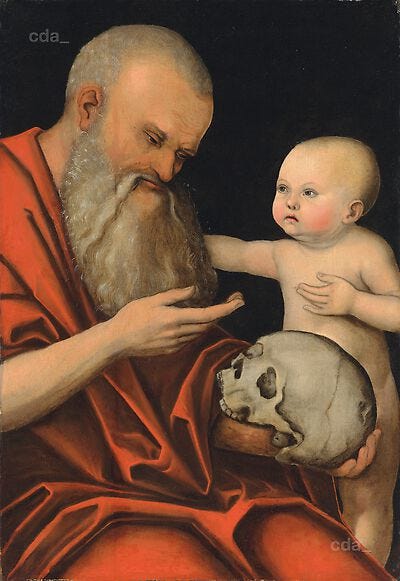
…so, I like eating my morning yoghurt with a Snow Peak camping spoon. I enjoy cutting grilled meat with a penknife. I embrace drinking from a tin cup.
I am just trying to figure out why.
I think it is because I want to learn to celebrate the potential of the transitory—a kind of nomadic existence where I might have to pick up the next morning and depart forever. Of course, this is largely imaginary. I have no real need to change my life suddenly. But I want to be ready. Ready for the reminder that life is indeed a fragile gift and that mortality, whether we acknowledge it or not, is always just around the corner. (Quite literally, as I steer my bicycle around the bends near Prats-de-Carlux!)
This fragility, in my mind, was understood most deeply by the artists and thinkers of the late Middle Ages and the Northern Renaissance. Perhaps it was one of the after-effects of the Plague. Or perhaps it was the natural melancholy of the North—with its incessant rain and long winter gloom—that made it easier to inhabit the idea of vanitas in painting, literature and prayer.
I am staying with my father-in-law right now. He is ninety-two.
It seems that when one reaches that age, many worries quietly become irrelevant. Needs and desires are reduced to their essentials. And there is something unexpectedly beautiful about that. It brings a certain lightness. As one faces mortality more directly, one’s remaining life seems less mediated by the mundane concerns that bombard us when we are younger. Facing death, paradoxically, can make one lighter.
Death has been close to me for a long time.
My father died when I was nine, and my grandmother, who lived with us, only a few years later. Since then, through other brushes with mortality, I have found an odd comfort in feeling the skull nearby—in resting my hand, metaphorically at least, upon the bone.
I think Cranach and his contemporaries understood something we have largely forgotten. There is something profoundly life-giving about remembering that we are temporary. That everything we love, and everything we fear, could change in an instant. The thought is unsettling, but it is also strangely consoling. We are simply part of the ebb and flow. Dust in the wind.
Everything matters enormously. And everything matters hardly at all.
That, perhaps, is the paradox of being human. Our purposes are essential, and yet they are also fleeting. We are called to live as though what we do matters infinitely, while remembering that we ourselves are only passing through.
Carpe diem tells us to seize the day. Perhaps carpe vanitas reminds us why.
Keep well, and remember the skull…
Gorgeous prose- and a worthy reminder- it strikes me that pop culture nods to this very point by fixating and flirting with life extending or pseudo life extending treatments/hacks. The truth, though, remains the truth. Merci, mon ami.