
AGAINST EXTRA CRAP…
In an age of excess, renouncing unnecessary "baubles" to discover truth...

…so, I remember being in a restaurant with a spectacular view when they lifted a bell-shaped dish cover to reveal a prettily arranged plate holding smoking peat or moss, cradling a small piece of finely poached salmon or Arctic char. I am sure there were razor clams, some variegated sorrel, and a slice of bottarga folded into the “experience.” In that moment, in a sort of childish trance, I was delighted by the theatricality of it all. I was waylaid from my true needs and wishes.
I have received wonderful gifts enclosed in multiple layers of paper and boxes, with secret envelopes, little custom screwdrivers bearing logos, special buttons, and other decorative flourishes. In those moments, the packaging and the unpacking were so beguiling. My eyes widened at each stage of the reveal, and I became, again, a little boy at Christmas, when the joy of opening the package almost equaled the joy of the gift itself. Almost always, though, the actual gift was a disappointment. The packaging outperformed the present.
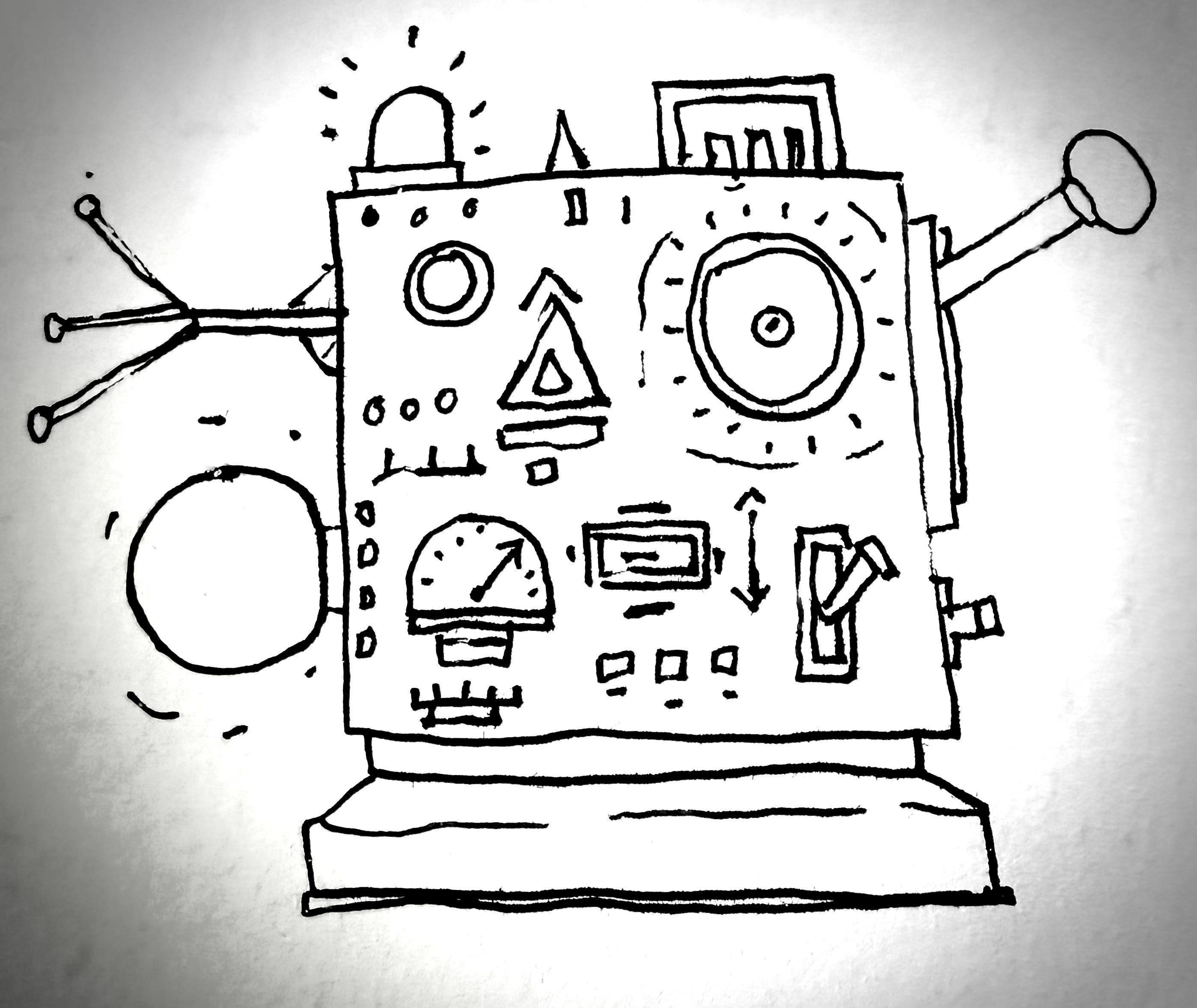
I have been similarly seduced by devices with extra buttons, flashing lights, and obscure functions, from the earliest Texas Instruments calculators to the iPhone 17 I am carrying now. The more functions, the merrier. I am perfectly capable of spending an hour discovering whether some arcane tool is hidden behind a button — or, better still, a mysterious combination of buttons and twiddles. There is pleasure in potential functionality, even when it is superfluous.
It is as though some part of our humanity becomes entranced by ornament: by the filigree, the flourish, the trill, the Baroque. Basic creation itself is not enough; we feel compelled to seek out the supercharged. Companies, institutions, and individuals understand this desire well, and they work tirelessly to satisfy it — or exploit it. Much of our world now runs not on meeting real needs, but on feeding our appetite for more. More features. More spectacle. More layers. More choice. It is profitable to keep us thirsty.
This runs counter to traditions of curation, distillation, and restraint: minimalism, of the Japanese ma and wabi-sabi — all those ways of shaping a life, a room, or an object toward what is essential. There are artists and creators who seek this kind of distilled effect: Agnes Martin, John Pawson, Patience Gray, Raymond Carver, Ryūnosuke Akutagawa, Charlotte Perriand, Arvo Pärt, and many others. Their work reminds us that reduction is not deprivation. It is concentration.
And yet they are outliers. Admired, yes — but still outliers.
Cory Doctorow coined the term in past articles and his recent book “enshittification” to describe how digital platforms and then other modern experiences begin by serving users well, then gradually degrade as they shift their attention toward profit, advertisers, and extraction. The original users’ needs are abandoned; usability declines; the owners simply do not care. It is a brilliant term because it names something broader than technology. Artificial intelligence, too, could be genuinely useful, but so much of what surrounds it already feels like slop — propaganda, noise, dancing cats set to Wham!, an endless production of both the trivial and the manipulative.
But this problem is older and deeper than the internet. George Orwell saw something like it in Nineteen Eighty-Four. In Oceania, constant war leads to the steady deterioration of food, clothing, and everyday objects, and people barely notice. The regime keeps them distracted, materially diminished, and historically unmoored. The past is obscured, the future emptied out, and only the thin present remains. Without memory or aspiration, there is no basis for comparison, no standard by which to judge decline. People become absorbed in the petty and immediate while the sleeves fall off their jackets and the coffee, though dark, is watery and tasteless. This is true of our time as well. Sloppy service, a quick buck, poor information, and increasing bureaucracy keep us occupied with the simplest of tasks. Meanwhile, as we are distracted, our governments, our services, our rights, our discourse, our world becomes “enshittified” and eroded. In our busyness, we don’t really have the time nor the energy to notice. William Morris complained about mass production and the general deterioration of quality as did Hannah Arendt.
So how do we resist this general this degradation of things and this distraction through extra crap being added to everything around us so we cannot tell what really matters from the irrelevant dross?
By living more simply, and by refining our pleasures. By returning to elemental satisfactions: a well-cooked meal made with good ingredients and shared with family or friends; a calm, serious conversation with someone who agrees with us or does not; time in nature, wherever we can find it — and the sky counts. Most importantly, we need to exercise our rights and freedom in order to still think independently, to still be determiners of our own and our collective futures. These small nudges and micro-tensions, help us relearn the value of what psychologists sometimes call “desirable difficulty”: struggling to appreciate and better understand something: Reading a hard text closely and widely; going for a walk and observing our whereabouts even when the weather is poor; sitting with art or music that does not yield itself immediately. These small authentic actions help return us to our humanity, to our truer selves, and to a position with the potential of an honest perspective.
These simple “nudge experiences” are not important in themselves. What matters is the quality of attention they invite, and where that attention may lead us. If we are lucky, they are small pebbles leading us towards a greater goal—some element of the truth. And truth is rarely ornate. It is usually simple, and often beguiling in its severity.
Of course, for those who have the talent and resilience, exercising a craft is a bulwark against the speed and efficiency that mitigates against thought and care. Craftspeople like Eiichi Suzuki of Gorsch, Boucherie Marty in the Victor Hugo market in Toulouse, Leander Angerer of Racing Atelier, Margot Henderson of Rochelle Canteen, Evan Kinori, Hassan Fathy, and Faye Toogood of Toogood are a few examples of individuals standing up for the human way of doing things, a human way that prizes simplicity and thoughtfulness. I will write more about this in another post, but it is good to know that we have people we can emulate in our quest to live simple lives of virtuous quality.
Keep well, and reduce things to their simplest and most elemental forms — not only for happiness or fulfillment, but for the possibility of truth…
I dislike the coordinated "reveal" in restaurants or at big dinners. Always a promise unfulfilled.